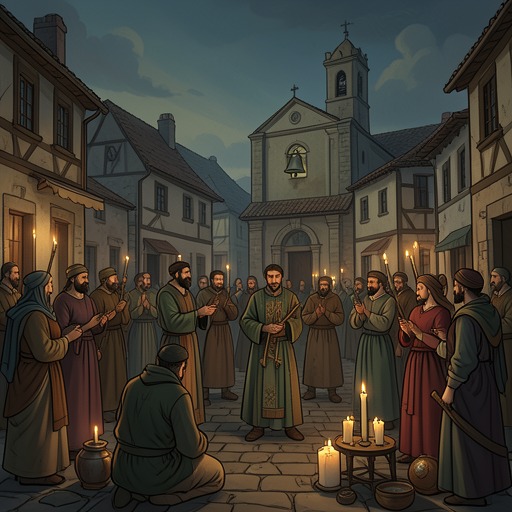
Lipce village church
The PeasantsLipce village church gathers the village around worship and the turning seasons, but it also makes social distinctions visible. The route from porch to altar, the places reserved for farmers, and the shared movement of a procession give belonging a physical form. For Kuba, who is mocked and treated as an outsider despite being born to a farming family, entering the church becomes a small but consequential assertion of dignity. At other times, its bells summon the living to remember the dead, seek confession, and celebrate Easter together.
Setting and approach
The church stands opposite the presbytery, with a road between them. The presbytery is set back in a large garden where pear and apple trees grow; its porch is overgrown with reddening vines, and white doves wander across the mossy roof. When Kuba approaches, he first peeks timidly through the church’s open windows and hallway. He does not dare enter at once, and retreats to a flowerbed of roses, stock, and asters. This threshold scene establishes the porch as a place from which he can look in on a community whose welcome he doubts.
The church square and surrounding roads change character with the occasion. During a crowded service, carts and unharnessed horses fill the square, their stamping and snorting audible in the dark, while carriages belonging to the manor disappear beneath the bell tower. Inside, the congregation presses together, its prayers, coughs, greetings, and sighs forming the sound of a community assembled in one place. The building is thus approached through ordinary village traffic, but its crowded interior turns that traffic into a collective religious gathering.
Kuba’s place among the worshippers
On Sunday, the bells ring out as a joyful summons to rest and prayer. Kuba has planned to wait until they finish before setting off, but impatience wins. He tells Witek to bring the cattle into the byre and come to church, then hurries along the orchard path despite his bad limp. He carries a bundle of birds under his capote, and arrives at the porch still unsure whether he belongs inside.
Kuba’s hesitation is sharpened by the way other villagers treat him. He says that the village calls him cripple, fool, and sponger, and that he receives neither kind words nor pity. The priest, by contrast, has shown him respect. After receiving a coin from the priest, Kuba walks toward the church with a new pride, drawing himself upright as best he can and moving with the slow dignity of a farmer. His conduct makes the approach itself a change: he comes not merely to watch the worshippers, but to take his place among them.
This time Kuba does not remain in the porch. He pushes through the crowd to the front, where farmers stand near Boryna and other prominent worshippers. The people around him look astonished and displeased; he hears harsh words and catches hostile looks. He ignores them, kneels near the rail, and sings with the congregation. The service’s images of the Father, the Lady of Częstochowa, gilded halos, candles, and colored light fill his attention. His spiritual absorption contrasts with the judgments directed at him outside the ritual: within the service, he experiences himself as part of a sacred gathering even while the human crowd resists his claim to its most honored place.
The liturgy draws the congregation into shared penitence and then into the High Mass. The Parish Priest of Lipce condemns sins including avarice, drunkenness, debauchery, neglect of the old, and godlessness; Kuba is overcome with remorse, and the people around him begin to weep and pray. The organ, bells, incense, and responses of the congregation deepen the sense of collective worship. When Ambrozy collects money for the candles, Kuba gives his coin and carefully takes his change. Later, when candles are distributed for the procession, he reaches out boldly but takes only a small stub after seeing Dominikowa’s disapproving look. His actions retain the tension between his desire to participate fully and the social scrutiny that continues even within the sacred space.
Bells, the dead, and communal memory
The church also stands at the center of All Souls’ Day, when the bells sound slowly from morning over the fields and call villagers to remember those who have died. The day’s grey weather and the gathering birds intensify the atmosphere of mourning. People make the sign of the cross, go to church, and bring offerings for the dead; beggars’ chanting can be heard from time to time near the church. Worship here is not separate from remembrance: the bells connect the living village to those buried beneath its crosses.
That connection extends to the graves near the graveyard fence, where Witek points out a light and Kuba recalls his dead family. Kuba identifies his mother as Magdalena and his father as Pieter, nicknamed Socha. He remembers that his father had land but served as a coachman at the manor, that his uncles took the land after his father died, and that he himself tended pigs before being employed with horses. He also remembers the young squire giving him a shotgun and the journey during which he was wounded. Returning later, Kuba found the manor buildings burned and the old master, mistress, his mother, and a maid beaten to death. The church’s All Souls’ observance therefore opens onto a history of family loss and violence that ordinary village life has not erased. The prayers spoken beside unmarked graves give Kuba a setting in which that history can be recalled and witnessed.
Seasonal gathering and shared ritual
In early spring, the church remains a destination even when the roads are bad and the weather unsettled. As women in red dresses pick their way toward it at the sound of the Angelus bell, people travel in from other villages for confession. The day shifts between rain, warm wind, hail, and brief sunlight, while at Hanka’s household preparations and chatter accompany the approaching feast. The church’s call organizes movement across the village amid these changing conditions: the bell gives a common time to people occupied with different tasks.
At Easter, the church becomes the point from which communal relief and celebration gather force. Lipce’s women arrive amid grief and confusion, and the priest comforts them with the hope that the imprisoned men will return. After he intones the hymn of the Resurrection, the organ and bells rise above the crowd. The priest carries the Most Holy Sacrament through incense, and the congregation processes around the church, singing as one. The scene makes collective worship a form of consolation for people separated from their husbands and relatives: the crowd’s shared movement does not undo their hardship, but it gives their grief a communal voice and a ritual shape.
Across Sunday Mass, All Souls’ remembrance, spring confession, and Easter, Lipce village church is both a devotional space and a social stage. Its rituals affirm common belief, yet the reactions to Kuba show that religious gathering does not automatically abolish village hierarchy. The church’s recurring bells and processions nevertheless make room for experiences that exceed those divisions: Kuba’s inward participation, the telling of a family’s losses, and the women’s united song turn the building and its grounds into a place where exclusion, memory, and communal hope meet.